The Week Our Gift Box Lids Wouldn't Stay Flat
- shaolin mo
- Jun 12
- 4 min read


There's a kind of silence in a packaging workshop that every factory owner learns to fear. Not the silence of machines turned off at night — the silence of five workers standing around one table, nobody talking, everybody looking at the same box.
That was my Tuesday morning, two springs ago.
We were in the middle of a 6,000-piece run of rigid gift boxes for a skincare client — magnetic closure, 2mm greyboard, wrapped in a soft-touch laminated paper the client had chosen after three rounds of sampling. Beautiful spec. The kind of box you pick up in a store and don't want to put down.
Except the lids wouldn't stay flat.
Boxes that came off the line looking perfect on Monday had developed a visible bow by Tuesday morning. Not dramatic — maybe 3 or 4 millimeters of lift at the corners — but on a magnetic closure box, 3 millimeters is the difference between a satisfying click and a lid that hovers open like it's thinking about something. The client was paying for the click.
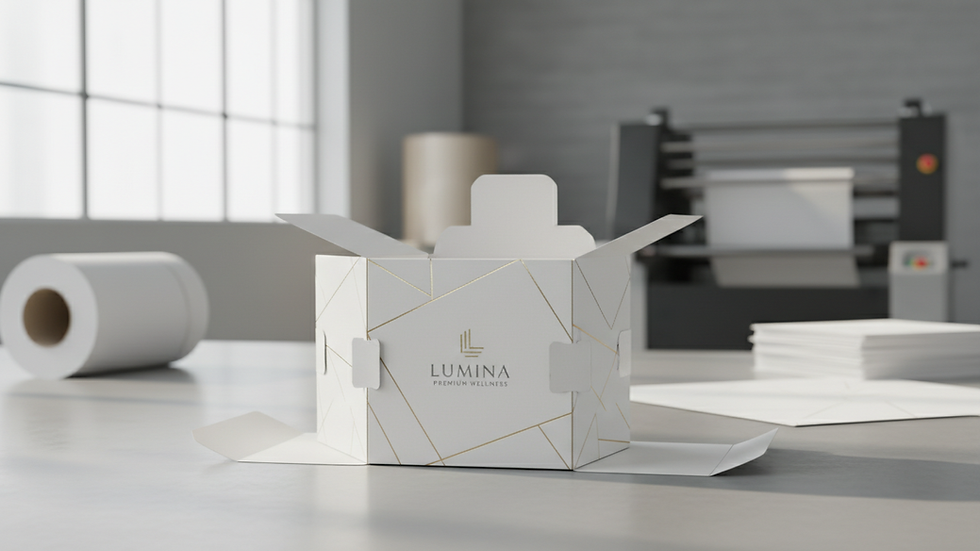
The part where I assumed wrong Gift Box
My first instinct was to blame the greyboard supplier. It's always tempting to blame the supplier — it means the problem isn't yours. We pulled boards from the same batch, measured thickness, checked density. All within spec.
Then one of our older wrappers, a woman who has been laminating boxes since before I owned this factory, picked up a warped lid, held it to her cheek for a second, and said: "回南天."
If you've never lived in Guangdong, "huinantian" needs explaining. Every spring, warm humid air rolls in from the South China Sea and meets surfaces that are still cold from winter. Walls sweat. Floors get slick. The air hits 90%+ relative humidity and stays there for days. And greyboard — which is essentially compressed recycled paper — drinks it in like a sponge.
Here's what was actually happening. The wrapped side of each lid was sealed under laminated paper and a layer of glue. The inside face was raw board, breathing freely. The raw side absorbed moisture from the air, expanded, and pulled the whole lid into a curve — always bowing toward the sealed side. Basic physics. Embarrassingly basic, once you see it. The boards had been fine; our process had been fine; the weather had changed, and we hadn't changed with it.
What we actually did about it
Some of the fixes were immediate and unglamorous. We pulled the unwrapped boards off the open racks and let them acclimatize in the workshop for 48 hours before wrapping, so the board's moisture content matched the room before we sealed one side of it. We ran dehumidifiers around the clock — our electricity bill that month was not fun to look at. We stopped stacking freshly wrapped lids in tall columns where the weight masked the warp until it set.
The structural fix mattered more. For that order and every magnetic-closure order since, we started lining the inside face of the lid — not for looks, but to balance the tension. When both faces of the board are sealed with paper pulling in roughly equal and opposite directions, the lid has no reason to curve. It costs a little more in material and one more pass on the line. It is much cheaper than 6,000 reworked boxes.
We also changed how we talk to clients. Now, when an overseas buyer asks me why I'm asking about their delivery month, this story is the answer. A box that ships from Zhongshan in dry November behaves differently from one produced during the spring humidity peak, and the production plan should know that in advance — board conditioning time built into the schedule, not discovered mid-run.
We saved the order, for what it's worth. About 400 lids were too far gone and got rebuilt from scratch. The rest flattened out under controlled drying, passed the closure check, and shipped nine days late with an apologetic email and a discount I didn't enjoy giving. The client stayed. They're still with us.
The thing I keep coming back to
People outside this industry think packaging problems are about machines and materials. Mostly they're not. Mostly they're about assumptions — the quiet ones you don't know you're making until a Tuesday morning proves you wrong. I assumed a process that worked in January would work in April. The board didn't care about my assumption.
These days, there's a cheap hygrometer hanging in every section of our rigid box workshop, and the morning humidity reading goes into the same group chat as the production schedule. It's a small ritual. It looks almost silly. But every craft has these small rituals, and behind most of them is a week somebody would rather not repeat.
If you're sourcing rigid boxes — from us or from anyone — here's the one question this story should leave you with: don't just ask a factory what materials they use. Ask them what goes wrong in their workshop, and what they changed afterward. A supplier who can't tell you that story hasn't been paying attention. Or worse, hasn't been honest with themselves.
We've been making boxes in Zhongshan long enough to have a few of these stories. This one just happens to be the one with the best weather report.
Mo runs BY Printings (ZSBOYA), a printing and packaging manufacturer in Zhongshan, Guangdong, specializing in custom rigid boxes and gift packaging for international brands. If you have a packaging problem of your own — or want to make sure you never meet this one — get in touch.


Comments