Two-piece rigid boxes: how to approve lid fit before production

For a two-piece rigid box, review the lid and base together, first empty and then with the complete product and insert. Agree how the reviewer will support the box, lift the lid and close it again. Record where movement becomes difficult, whether the lid seats as intended and what changes after loading.
That gives a packaging supplier something more useful than “make it a little tighter.” It also helps an overseas buyer and a packing factory in China compare the same sample in the same way.
This guide covers a separate lift-off lid and base. Hinged magnetic boxes, drawers and folding-carton closures need checks suited to their own construction.
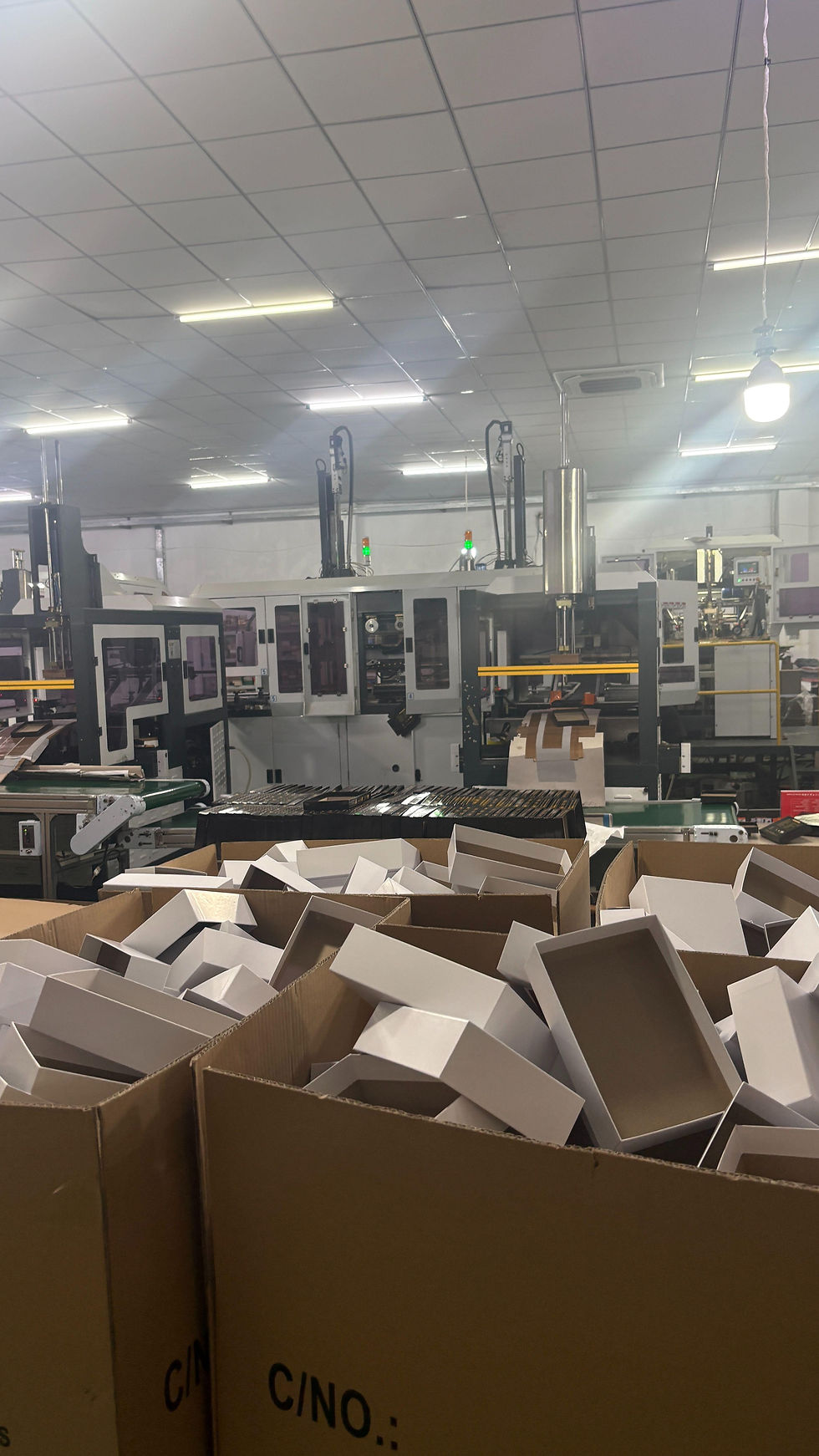
Workshop photograph supplied by BOYA. The checks in this guide apply to the completed lid, base and product assembly.
Describe the opening you actually want
Start with the normal use. Will the customer open the box on a table? Where can their fingers hold the base? How much of the base should remain visible when the lid is closed? Is an insert, ribbon or product projection close to the lid?
Agree the intended closing position and the actions that should be possible without an improvised workaround. A deep overlapping lid and a shallow lid may need different handling instructions.
Avoid approving a universal gap, opening force or release time from another product. If your project needs a numerical limit, have the responsible technical team define the measurement method, sample quantity, conditions and acceptance range. Keep that agreement with the drawing and approved sample.
Make sure the sample represents the finished pair
Identify both components by sample and drawing revision. Confirm whether quoted dimensions describe the finished inside or outside size, and ask where those dimensions will be measured.
List the board, outer wrap, lining, surface finish and any features at the contact area. Record differences between the sample and intended production. An unfinished structure can help answer a size question while leaving the finished contact surfaces unapproved.
Ask how the samples were stored before the review. Temperature and humidity matter when comparing paper-based packaging: ASTM D4332 explains why conditioning is important for meaningful, repeatable packaging tests. Agree suitable conditions for the project rather than borrowing a conditioning time from an unrelated case.
For the wider distinction between structural and production-representative samples, see BOYA’s packaging sampling guide.
Review the empty box with one consistent method
Place the base on a stable surface. Agree the support and grip positions, the lid orientation and the direction of movement before comparing samples. Support the base as intended during normal opening; do not use suspending the filled box by its lid as a general fit check.
Close the lid gently to the agreed position, then open it using the agreed action. Observe:
Whether the lid starts squarely or catches at a corner.
Whether it seats evenly or stops short.
Whether one side drags while another moves freely.
Whether opening needs an extra twist, squeeze or repeated adjustment.
Whether the base moves unexpectedly or is difficult to hold.
Describe the location and stage of the problem. “Catches at the rear-right corner during the last part of closing” is more actionable than “too tight.”
Keep the original lid and base identities clear. If production requires components to be interchangeable, ask the supplier how that will be checked across the agreed sample set. One selected pair does not establish interchangeability.
Repeat with the complete contents
Use the intended product, insert, accessories, leaflet and any protective bag or tissue. Record substitutions if the actual components are unavailable.
Check whether the lid reaches the same agreed position. Look for an insert standing proud, an accessory trapped near the edge or a product projection contacting the lid. Ask the receiving factory to repeat the intended packing sequence rather than rearranging the contents until the sample happens to close.
Compare the observations with the empty-box result. If a lid closes normally when empty but stops short when loaded, record that difference before asking for a size change. The assembly needs review; the observation alone does not identify which component should be altered.
Check product removal too. The customer should be able to reach the product in the intended way after lifting the lid. Record any insert movement, snagging or contact marks that appear during that action.
Check repeated use and visible contact
Agree how many opening and closing cycles the review will include. Keep the method consistent and note when an observation first appears.
Photograph the contact areas before and after, using comparable light and viewing angles. Look for rubbing, colour transfer, lifted wrapping, damaged corners or a change in seating. Distinguish a pre-existing mark from one first observed during the review.
This is a project-specific functional check. If surface abrasion needs laboratory measurement, agree a suitable test separately. Repeated hand opening should not be described as a standardized abrasion test.
Also keep distribution protection separate. A satisfactory lid fit does not establish that the packed product will survive shipment. ISTA’s design and testing guidance addresses representative test samples and agreed acceptance criteria for distribution testing.
Give the supplier an issue record it can act on
For each observation, keep:
Sample ID and the paired lid/base references.
Drawing revision, materials and finish represented.
Empty or fully loaded configuration, with component versions.
Review conditions, support method and opening/closing action.
Exact location, stage and repeat count at which the issue appeared.
Photographs or video linked to the sample.
Required outcome, decision owner and next sample to review.
An illustrative review note might read: “Sample R2-03 seats evenly when empty. With product kit P4 and insert I2, the rear edge remains above the agreed closing position. See photos 03–05. Supplier to review the assembled configuration and return a revised sample before lid-fit approval.”
That note records an observation without guessing a cause or authorizing an unreviewed material change.
Keep the accepted reference pair and written criteria together. If the board, wrap, lining, finish, dimensions or contents change, decide which checks must be repeated. Add the resulting decision to the packaging proof approval record.
Send a focused rigid-box brief
To discuss a two-piece rigid box with BOYA, send a project brief with product dimensions and weight, complete contents, proposed lid style, opening expectations, quantity by SKU and sample destination. If a factory in China will pack the product, include its assembly requirements and contact role.
Mark provisional dimensions and unresolved fit questions clearly. Construction, sampling scope, manufacturing method, cost and timing need confirmation for the specific project.


Comments