Hand-hole corrugated cartons: approving the fully packed sample

Before approving a hand-hole corrugated carton, connect the proposed carrying use to the exact packed sample. Record the complete weight, contents, carton construction and assessment conditions, then close any exceptions before release. An empty printed sample cannot answer how the package will behave with the product inside.
The practical question is specific: what evidence supports using this opening on this carton, with this packing arrangement? The following review helps buyers frame that question with their supplier. It is not a load rating, a standardized test procedure or a manual-handling safety guide.
First, agree what the opening is for
Ask the supplier whether the aperture is intended for lifting, assisting another handling operation, or a different purpose. Describe where the carton will be handled and what movement is expected. A top opening does not, by itself, establish that one-handed carrying is suitable.
The public summary of ASTM D6804-24a, Standard Guide for Hand Hole Design in Corrugated Boxes distinguishes lifting hand holes from other openings and says the supplier and user should agree on use and cautions. Citing that guide does not certify a particular carton or packed weight.
Put the agreed use in the sample brief. If it remains uncertain, keep carrying approval open and ask the supplier or a competent testing provider how to assess it safely.
Record the whole packed weight
Product weight alone leaves part of the package unaccounted for. Record the measured total for the closed carton, including the product, accessories, inserts, bags, printed instructions and carton itself. State the measurement unit and the SKU represented.
BOYA Printing's appliance-carton reference page, in Chinese asks buyers to supply total packed weight, accessories, inserts and packing orientation. Its sample photograph does not establish a board specification or carrying capacity for another project.
Keep a packing list beside the weight record. If several SKUs share the same outer dimensions, identify their different contents and packing arrangements. Ask which versions the evaluation must cover; approval of one arrangement should not silently extend to all of them.
Identify the actual sample construction
Attach the sample identifier and dieline revision to the proposed production specification. Include the board construction, cutout location, fold direction, closure method and any reinforcement. Record substitutions used for sampling so the assessor knows exactly what was evaluated.
Use photographs to document the sample, but obtain material details from the specification. A photograph cannot reliably establish flute type, layer count or carrying performance.
For the wider questions of dimensions, product clearance and packing layout, use the custom packaging fit guide. Keep the hand-hole review focused on the assembled opening and the packed carton it belongs to.
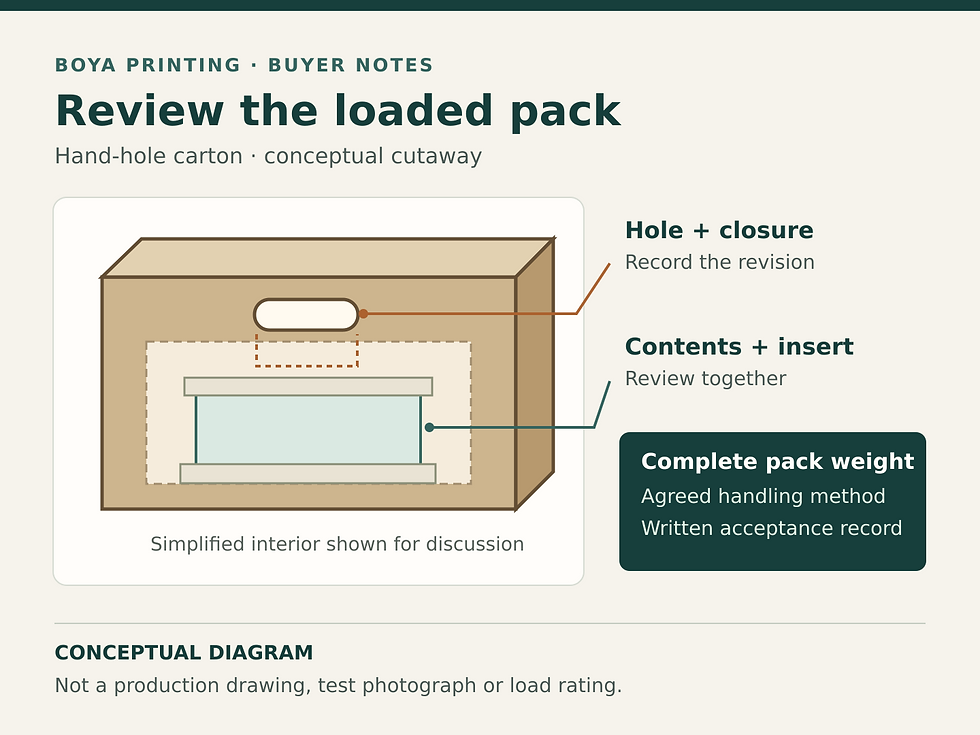
Conceptual illustration of a hand-hole carton review. Not a production drawing, test photograph or load rating. Actual construction and assessment requirements are project-specific.
Check what is behind the hand hole
Review the closed sample with its actual contents and inserts in position. Document whether overlapping flaps reduce the opening, whether the product or insert occupies the space behind it, and how the cut edge or folded flap would contact the hand.
Start with the carton securely supported for visual inspection, using the agreed review method. Any hands-on access check should follow the project's safety assessment. Do not improvise a lift of an unknown or heavy package.
If a clearance problem appears, mark its location on the sample record. A proposed larger opening, moved insert or changed closure needs a revised structural review; it should not be treated as a cosmetic adjustment.
Agree the assessment before anyone tests it
Ask the supplier or competent testing provider to define a suitable controlled evaluation for the intended use. Agree who will perform it, the sample quantity, packed configuration, environmental conditions, method and acceptance criteria. Any loads, repetitions or holding times must come from that project-specific plan.
ISTA's design and testing guidance emphasizes samples that represent production and damage criteria set before testing. Those principles are useful when planning a review; the steps in this article are not an ISTA procedure or certification route.
Confirm separately what distribution testing the packaging needs. A hand-hole assessment does not resolve the package's other transport requirements. Keep the assessment scope visible so a carrying result cannot become an unsupported claim about shipping performance.
Describe failures and close exceptions
Before evaluation, agree how observations will be classified. Useful discussion points include tearing around the opening, separation of material layers, lasting panel deformation, closure movement, and movement of the product or insert. The assessor should identify any additional failure modes relevant to the design.
Record each observation against the sample identifier, location and stage of the assessment. Keep photographs with the written result. Avoid a bare “passed” entry that leaves the method or acceptance rule unstated.
Pause release if a carrying-related concern is unresolved. Record the required correction and who owns it. Ask whether a revised sample or further evaluation is needed before accepting the affected use.
Keep a short carrying-approval record
The record can sit alongside the packaging proof approval checklist. Include:
SKU, sample identifier, date and dieline revision
Complete packed weight and unit, contents list and packing orientation
Board, closure, cutout and reinforcement references, including sample substitutions
Agreed hand-hole use, restrictions and assessment method
Results, photographs, exceptions and required follow-up
Named approval owner, decision date and exact release scope
Match the print proof to that same structural revision. If the opening moves, recheck nearby instructions, labels and artwork. Keep a visual approval distinct from permission to use the carton for carrying.
For a project discussion, contact BOYA Printing with the product dimensions, total packed weight, intended hand-hole use and available sample information. Include the quantity for each SKU and its unit, such as cartons or complete packaging sets, plus the delivery destination and target date. Flag estimates and unresolved requirements.


Comments